Free AI tools don’t create income on their own. They help you produce useful results faster, such as stronger research, quicker customer support, better content, simple websites, or working software that solves a real problem.
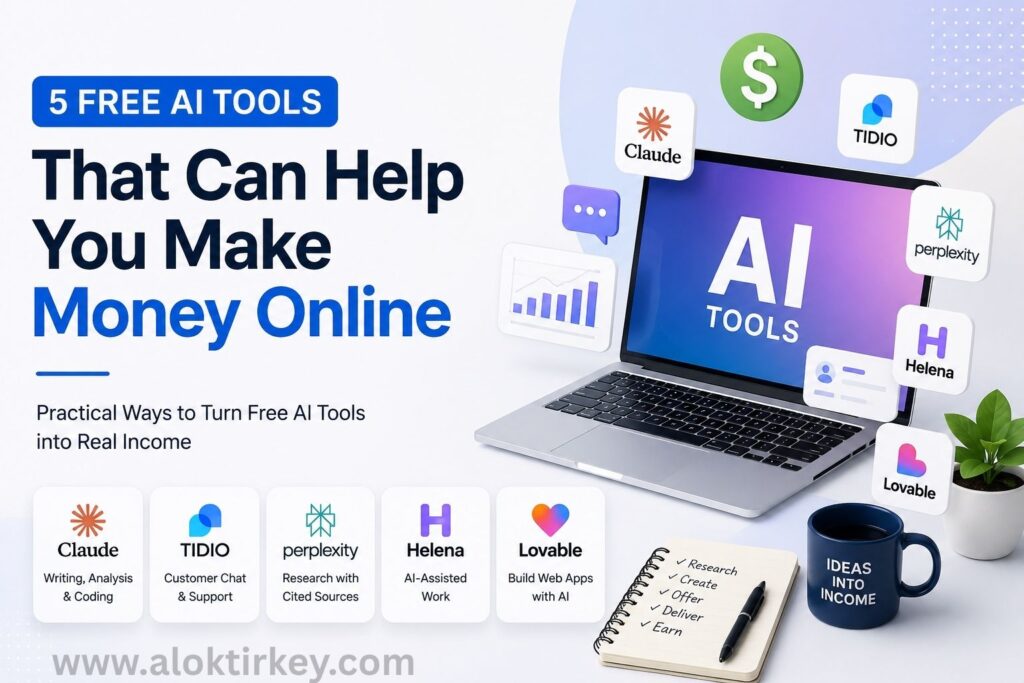
This guide looks at five tools you can test without paying upfront: Claude for writing, analysis, and coding; Tidio for website chat and customer support; Perplexity for research with cited sources; Helena AI for AI-assisted work; and Lovable for building web apps with natural-language prompts. Each can help beginners, freelancers, creators, and small business owners turn saved time into a service or product people will pay for.
Key Takeaways
- Free AI tools can help you earn money by speeding up services such as writing, research, customer support, website creation, and software development.
- Claude is useful for writing, research, coding, content repurposing, and small business automation services.
- Tidio can support chatbot setup, lead capture, customer service automation, and ongoing support for businesses.
- Perplexity can help you create cited research reports, niche newsletters, product comparisons, and market briefings.
- Lovable can help you build small client MVPs, micro-SaaS products, and reusable templates, while Helena AI requires verification before you rely on it.
Free plans have limits, and pricing, features, and usage allowances can change. Competition is also high, so copying generic AI output won’t be enough. You’ll still need to fact-check research, review customer-facing content, protect client information, and sell a clear result instead of selling “AI” by itself. The following sections show practical ways to use each tool and where its free plan may fall short.
Claude Can Turn Writing, Research, and Coding Skills Into Paid Services
Claude can help you produce high-quality drafts, organize large documents, develop marketing material, and improve code. The paid skill is not generating text or code. It is delivering a useful result that saves a client time or helps the business reach a clear goal.

The fastest Claude offers to test with real clients
Start with one niche and one clear result. A local service business, agency, founder, or newsletter owner is easier to approach when your offer solves a defined problem.
- A local business may need regular marketing emails but lack the time to write them. Claude can suggest angles, subject lines, and first drafts. You must add customer knowledge, brand voice, offers, and a careful edit. Sell a five-email sequence as a fixed-price project, then offer a monthly email package. Build a sample sequence for a fictional home-services company as your portfolio.
- Founders often have scattered competitor notes and no useful summary. Claude can organize source material, compare positioning, and create a research brief. You must check every important claim, cite the sources, and add practical insight. Package one competitor report at a fixed price or provide a monthly market-monitoring service. A cited research brief makes a stronger portfolio piece than a generic article.
- Agencies and newsletter owners may have one interview, webinar, or report that needs wider distribution. Claude can turn it into social posts, newsletter sections, video scripts, and article outlines. You must select the strongest ideas and adapt each asset to its platform. Offer a content-repurposing bundle or a recurring monthly package. Show one source transformed into several polished samples.
- Small companies may need a workflow script, document review, or simple internal tool. Claude can explain code, identify errors, and help build or improve software with Claude Code where available. You must test the result, protect private data, and document how it works. Sell a small automation as a fixed project, followed by maintenance if needed.
You can find prospects on Upwork, Fiverr, and LinkedIn, or contact businesses directly. Choose a narrow audience before you publish an offer, and promise an outcome rather than “AI content.”
How to use Claude without selling low-quality AI content
Begin with the client’s source material, goals, audience, examples, and constraints. Give Claude that context, then request an outline before asking for a draft. Verify claims against original sources, edit for the client’s voice, and deliver an asset the client can use immediately.
Generic articles and unedited AI copy are weak offers because clients can produce similar material themselves. Your value comes from judgment, accuracy, structure, and useful recommendations.
You can also use Claude to create a digital product, training material, or internal business document, but only when it solves a specific audience problem. Fact-check the result, add original insight, protect confidential information, and check current free-plan limits before promising delivery terms.
Tidio Helps You Make Money by Improving Customer Support and Leads
Tidio is a customer engagement and chatbot platform, not a passive income button. You can use its AI agent, live chat, automated replies, and lead forms to help businesses answer questions faster and capture more sales opportunities. Your main offer is the setup and ongoing management, not access to the software alone.
Restaurants, online stores, coaches, real estate agents, education businesses, and local service companies can all benefit. However, Tidio’s free plan has limited billable conversations, so larger workloads or client accounts may require paid tiers. Confirm current limits and pricing before you include software costs in your proposal.

Sell a simple Tidio chatbot setup instead of vague AI services
Create a beginner package with a clear deliverable. Start with a support audit, then build a knowledge base from the client’s common questions, policies, product details, and service information. Add a welcome message, lead capture form, and escalation path to a human agent.
Your basic package can include:
- A review of current support questions and response gaps.
- Automated replies for the most common customer requests.
- A form that collects a name, email, phone number, or inquiry details.
- Human handoff when the bot lacks an answer or the customer requests help.
- Basic testing on desktop and mobile, including incorrect or unclear questions.
Before contacting prospects, create a working demo for one business type, such as a Shopify clothing store or a local dental office. Show the welcome flow, an FAQ answer, a lead form, and a human handoff. A specific demonstration gives prospects something concrete to evaluate.
After setup, offer recurring revenue through monthly updates, analytics reviews, staff training, new automated replies, and maintenance. Find clients through Upwork, Fiverr, LinkedIn, and local business groups. Shopify developers may also refer store owners who need customer support automation. Web designers, marketing agencies, and general freelancers can become valuable referral partners.
Use Tidio to connect conversations with sales
Build flows that guide visitors toward a useful next step. An online store can answer product questions, recommend items, and send an abandoned-cart reminder. A coach can collect details for an appointment, while a real estate agent can qualify a buyer before scheduling a call.
Tidio can connect with platforms such as Shopify, WordPress, Zapier, and selected email tools. You can send permission-based contact details to a CRM, email list, or booking workflow. Where available, ask customers whether they want email or WhatsApp follow-up before collecting or sharing that information.
Measure response time, qualified leads, booked calls, resolved conversations, or recovered carts. Avoid promising a fixed conversion increase because results depend on traffic, pricing, and the sales process.
Also disclose when customers are interacting with AI. Never send spam, hide affiliate links in chatbot replies, or collect personal information without clear consent.
Perplexity Can Power Research Services, Reports, and Niche Newsletters
Perplexity can search the web, find relevant sources, summarize pages, compare products, and monitor current topics. You can monetize that research layer by delivering clear findings to people who lack the time to gather and verify information themselves.
Build a paid research offer with a repeatable Perplexity workflow
Choose one niche before opening a freelance profile. SaaS competitors, local healthcare marketing, creator tools, e-commerce products, and emerging technology are easier to serve than “any research project.”
Use a consistent process:
- Ask focused questions instead of requesting a broad article.
- Collect a small group of reliable sources, including company pages, regulatory documents, primary studies, and reputable publications.
- Open the original pages and check every important claim, date, number, and quotation.
- Present the findings in a short report with links, a clear summary, and practical next steps.
Possible deliverables include a two-page competitor snapshot, a weekly technology brief, a YouTube research sheet, a blog outline with cited sources, or a product comparison for an online store. Each report should separate verified facts from your interpretation.

Create one strong sample for your chosen buyer. Show the research question, source links, concise findings, and recommendations. Then pitch content teams, founders, newsletter writers, agencies, and small businesses through LinkedIn, Upwork, Fiverr, or direct email. Offer a fixed project first, then suggest a recurring brief if the topic changes often.
Turn trusted Perplexity research into a newsletter or referral channel
A useful weekly update can grow an email list when it serves a narrow audience. For example, a technology newsletter might summarize five important product launches, explain why each matters, and link to original announcements. After building trust, you can sell paid subscriptions, sponsorships, digital reports, or carefully selected affiliate products.
A weekly free report could become a paid monthly briefing with deeper competitor analysis, source notes, and actionable recommendations. Keep promotional content limited, and disclose affiliate relationships clearly.
Referral income requires extra caution. Check the official program terms before promoting any Perplexity or partner offer because payout amounts, qualifying actions, geographic access, and program status can change. Current referral terms have included restrictions, holding periods, and specific requirements such as a new user completing an action. Earnings are usually small per conversion and depend on an active program, qualified referrals, location, and audience trust. Spammy promotion can damage the newsletter that creates your earning potential.
Helena AI Needs a Name Check Before You Try to Monetize It
Public information does not clearly verify a widely available standalone product called Helena AI as of July 2026. The name may refer to Helena Autonomous AI Marketer from Enrich Labs, a private beta, another product, or Helena DiBiase’s broader ideas about using AI to make money. Treat the name as a lead to investigate, not proof that a usable free tool exists.
How to validate an unfamiliar AI tool before offering it to clients
Before you build an offer around Helena AI, complete a basic verification check. Confirm the official website, developer, current pricing, privacy policy, and actual product features. Also check whether the service is available in your country and whether individual users can access it.

Use the free version, if one exists, and test it with a low-risk sample. Read its data retention and copyright terms before uploading client information or promising ownership of generated work. Check export formats, integrations, usage limits, account restrictions, and support options. Then run a small pilot with one task and measure the result.
A social media post or vague claim about AI earnings cannot confirm reliability, access, or client value. If you cannot verify the tool, don’t promise results based on its name. Describe your service around the outcome instead, such as qualified leads, faster document processing, or less manual work.
Use the Helena-style strategy to sell a small business solution
You can still use the general strategy associated with Helena without depending on unverified features:
- Choose one niche and interview potential customers.
- Find one repeated, costly task, such as lead qualification, multilingual replies, recruitment screening, compliance document preparation, or appointment follow-up.
- Build the smallest useful workflow with verified tools.
- Test it with one user, keeping human review and privacy controls in place.
- Charge for implementation or ongoing access based on the business result.
For example, you could create a lead-follow-up workflow for a home-services company, then price it around setup and qualified appointments. Keep sensitive data protected, disclose AI involvement where appropriate, and review every important output before delivery.
Lovable Lets You Build Paid MVPs, Micro-SaaS Products, and Templates
Lovable lets you describe a web app in natural language, then generate a working interface and supporting software. It can help you create functional prototypes with forms, dashboards, user flows, and basic data handling without starting every feature from scratch.
The free plan has limited credits, so use it for focused experiments rather than a full production launch. Hosting, databases, payment processing, APIs, email, and other services may create separate costs. Supabase can support user accounts and stored data, while Stripe, Gumroad, Lemon Squeezy, or Paddle may handle payments, but check current Lovable support and each provider’s terms before committing.

Earn sooner by building small client MVPs with Lovable
Start with a narrow use case for one type of customer. Accountants, law firms, landscapers, home service companies, and other businesses with weak online tools may pay for a simple app that removes manual work.
A sensible workflow looks like this:
- Write the problem in one sentence, such as “help homeowners request and compare service quotes.”
- List only the essential features, including the pages, forms, user roles, and key actions.
- Build a clickable version with Lovable and test the main path yourself.
- Share it with the client, gather feedback, and revise the confusing parts.
- Deliver a clean handoff with login details, setup instructions, and basic documentation.
Useful portfolio demos include a quote calculator, booking dashboard, lead tracker, or client intake portal. Price each project according to scope, business value, revisions, and support, not the number of prompts you used. Find prospects through Upwork, Fiverr, local outreach, startup groups, and build-in-public posts.
Before launch, test permissions, security, mobile layouts, data storage, validation, and error handling. A prototype that looks polished can still expose private records or lose submitted forms.
Turn one successful Lovable build into a product you can sell repeatedly
When several clients request the same workflow, interview potential buyers before turning it into a micro-SaaS product. Build the smallest version, offer a free trial or limited free tier, and charge with subscriptions, credits, or usage limits.
Micro-SaaS usually takes longer and carries more risk than client work, so validate demand before paying heavily for hosting or ads. A reusable template is a lower-risk option. Include screenshots, documentation, setup instructions, and reasonable support so buyers can install it without guessing.
You can sell through a personal website, Gumroad, a template marketplace, social content, or relevant communities. A working client solution can become your first product sample, but remove private data and confirm that every integration can support public sales.
Choose the Right Free AI Tool for Your First Money-Making Experiment
The best free AI tool depends on your existing skills, access to customers, comfort with technical work, and how quickly you need to deliver value. Start with one narrow problem, then test whether someone will pay for the result.

### Compare service income, digital products, referrals, and software revenue
Each income model has a different balance of speed, risk, and required trust.
| Model | Best starting tool | Main trade-off |
|---|---|---|
| Services | Claude, Tidio, or Perplexity | You can earn sooner, but delivery depends on client work |
| Digital products | Claude or Perplexity | Products scale better, but distribution and trust take time |
| Referrals | Perplexity or a tool with an active program | Setup is simple, but earnings depend on program rules and audience size |
| Software revenue | Lovable | Recurring income is possible, but testing, support, hosting, and other costs continue |
Choose Claude for writing and analysis, Tidio for chat and lead capture, and Perplexity for sourced research. Consider Helena AI only after confirming its identity, official provider, features, access, and pricing. Current information identifies Helena as Enrich Labs’ business marketing product, not a widely available income tool for individuals. Choose Lovable when you want to test an app prototype or small software product.
For most beginners, services are the best first experiment. Client work reveals a real problem and gives you feedback before you spend time building a course, template, or app. When the same task appears repeatedly, turn your process into a digital product or small software tool.
A simple rule for turning saved time into real income
Saved hours only become money when they improve a result someone values. Track a before-and-after measure, such as hours saved, leads captured, replies handled, reports delivered, or sales opportunities created.
Run a seven-day test:
- Choose one audience and create one useful demo.
- Write one simple offer tied to a measurable result.
- Contact a small number of relevant prospects.
- Collect objections and feedback, then improve the offer.
Reinvest early revenue into better processes only after demand is clear. Keep client data private, follow platform terms, disclose affiliate relationships, and check current pricing and free-plan limits before making claims. Avoid chasing passive income, copying raw AI output, hiding AI use when disclosure matters, or buying upgrades before customers validate the idea.
Conclusion
Claude, Tidio, Perplexity, Helena AI, and Lovable can help you deliver useful work faster, but none guarantees income. Claude supports writing and coding services, Tidio helps businesses manage chats and leads, Perplexity strengthens research, and Lovable helps turn app ideas into working prototypes. Helena AI requires extra care because the name refers to several unrelated products, so verify the specific provider before using it.
The strongest opportunity is still a narrow, useful offer. Choose one problem that matches your skills, build a small example, and show it to a real audience. Then measure a result such as hours saved, leads captured, reports delivered, or qualified appointments. Saved time only becomes revenue when it improves something a customer values.
Start with the tool that fits your current abilities and test one simple paid offer this week. Before relying on any plan, pricing, feature, or referral claim, check the tool’s official website and current terms. That practical test will tell you more than another list of AI income ideas.
Read Also: 25 Digital Products to Sell Online in 2026, Beginner Guide
Frequently Asked Questions About Making Money With Free AI Tools
What are the best free AI tools for making money?
The best tool depends on the service you want to sell. Claude fits writing, research, and coding services; Tidio fits chatbot and customer support setup; Perplexity fits sourced research; and Lovable fits app prototypes and small software products. Verify Helena AI’s identity, access, features, and pricing before using it in a paid offer.
Can you make money with Claude?
You can use Claude to deliver services such as email writing, competitor research, content repurposing, document review, and small business automation. Clients pay for the useful result, accuracy, editing, and judgment you provide, not for raw AI output.
How can beginners use Tidio to earn money?
Beginners can create a Tidio chatbot setup package for a specific business type. The package can include a support audit, automated replies, a lead form, human handoff, mobile testing, and ongoing updates. Confirm Tidio’s current free-plan limits before including software costs in a proposal.
Is Lovable suitable for building a business?
Lovable can help you create focused web app prototypes, client MVPs, micro-SaaS products, and reusable templates. Test the main user flow, permissions, security, mobile layout, data storage, and error handling before launch. Hosting, databases, payments, APIs, and email services may add separate costs.